
Search the Space Transportation Site:
About X-33
X-33 Program Status
X-33 Tank Report
X-33 Demonstrator
Specs
Internal/External
Configuration
Flight Profile
X-33 Images
Internet Cameras
IPIX™ Images
Partners


About . . . X-33
 The wedge shaped X-33, being developed under a cooperative
agreement between NASA and Lockheed Martin Skunk Works of
Palmdale, California, is a subscale technology demonstration
prototype of a Reusable Launch Vehicle (RLV) which Lockheed
Martin has labeled "Venture Star," and which the company hopes to
develop early in the next century. Through demonstration flights and
ground research, NASA's X-33 program will provide the information
needed for industry representatives such as Lockheed Martin to
decide by the year 2000 whether to proceed with the development of
a full-scale, commercial RLV program.
The wedge shaped X-33, being developed under a cooperative
agreement between NASA and Lockheed Martin Skunk Works of
Palmdale, California, is a subscale technology demonstration
prototype of a Reusable Launch Vehicle (RLV) which Lockheed
Martin has labeled "Venture Star," and which the company hopes to
develop early in the next century. Through demonstration flights and
ground research, NASA's X-33 program will provide the information
needed for industry representatives such as Lockheed Martin to
decide by the year 2000 whether to proceed with the development of
a full-scale, commercial RLV program.
A full-scale, single-stage-to-orbit RLV will dramatically increase
reliability and lower costs of putting a pound of payload into space.
By reducing the cost associated with transporting payloads into Low
Earth Orbit (LEO), a commercial RLV would create new
opportunities for space access and significantly improve U.S.
economic competitiveness in the worldwide launch marketplace.
NASA will be a customer, not the operator, of the commercial RLV.
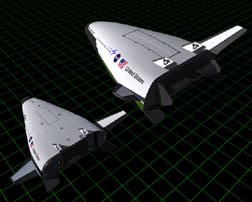 |
X-33 compared to RLV – What's the difference? |
The X-33 design is based on a lifting body shape with two revolutionary "linear aerospike" rocket engines and a rugged metallic thermal protection system. The X-33 also features lightweight components and fuel tanks built to conform to the vehicle's outer shape.
The X-33 will be an unpiloted vehicle, taking off vertically like a rocket, reaching an altitude of up to 60 miles and speeds faster than Mach 13 (13 times the speed of sound), and landing horizontally like an airplane.
Time between the X-33 test flights will normally be seven days. However, the X-33 program will demonstrate a two-day turnaround between flights during the flight-test phase.
For more information about NASA's plans for space transportation technology, click here.