
Search the Space Transportation Site:
About X-33
X-33 Program Status
X-33 News Releases
X-33 Tank Report
X-33 Demonstrator
Specs
Internal/External
Configuration
Partners

X-33 Program Status
February 7, 2001
Qualification Testing on X-33 Flight Engines Now Underway at Stennis Space Center, Miss.
Qualification test firings of the unique engines designed to propel
America's X-33 space plane into high-speed, suborbital flight in
2003 began Tuesday at NASA's John C. Stennis Space Center
in Bay St. Louis, Miss.
The ignition test went the full scheduled duration of 1.1 seconds
with no observed anomalies.
The engines will power the X-33, a half-scale, sub-orbital flight
demonstrator of technology required for a reusable launch
vehicle.
"Initial indications are all test objectives were met in this first test
of the flight engines," said Mike McKeon, program manager for
the XRS-2200 aerospike engine at the Rocketdyne Propulsion &
Power business of The Boeing Company. "We are now
reviewing the data and preparing to move into longer duration
testing."
"I'm excited about beginning this phase of testing," said Dr. Don
Chenevert, NASA's X-33 project manager at Stennis. "I'm
confident the remainder of dual-engine testing will perform
equally as well as this initial ignition test."
Eight more test firings of the twin flight engines are planned at
Stennis before they are delivered to Lockheed Martin's X-33
assembly facility in Palmdale, Calif.
Fourteen single-engine test firings of a development
configuration of the unique Aerospike engine were successfully
completed at Stennis Space Center in May 2000.
Boeing Rocketdyne developed the XRS-2200 Aerospike engine
at its Canoga Park, Calif., facility. Final engine assembly was
done by the NASA/Boeing Rocketdyne team at Stennis Space
Center.
The X-33 project is being developed under a cooperative
agreement between NASA and Lockheed Martin Space Systems
Company, Denver, Colo. Marshall Space Flight Center in
Huntsville, Ala., manages the X-33 program for NASA.
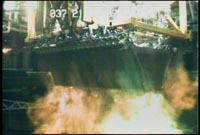 Initial tandem test firings of the XRS-2200 Linear Aerospike
engines will be short bursts such as this, eventually leading to
durations required to send the unpiloted vehicle from a launch
pad in California to landings in either Utah or Montana.
Initial tandem test firings of the XRS-2200 Linear Aerospike
engines will be short bursts such as this, eventually leading to
durations required to send the unpiloted vehicle from a launch
pad in California to landings in either Utah or Montana.
Back to X-33 Program Status